
Upgrading the sound system in a luxury car isn’t about swapping a few speakers — it’s an engineering problem. Every high-end vehicle has its own audio architecture, and the upgrade has to work with that architecture, not against it. In this case study, we walk through two very different luxury sound projects completed in Dubai: a 2011 Rolls-Royce Ghost with a fibre-optic MOST network, and a 2019 McLaren 720S Mansory with a factory amplifier system. Same goal — better sound, factory-clean integration — but two completely different technical paths.
Two Vehicles, Two Approaches
Case 1: Rolls-Royce Ghost (2011)
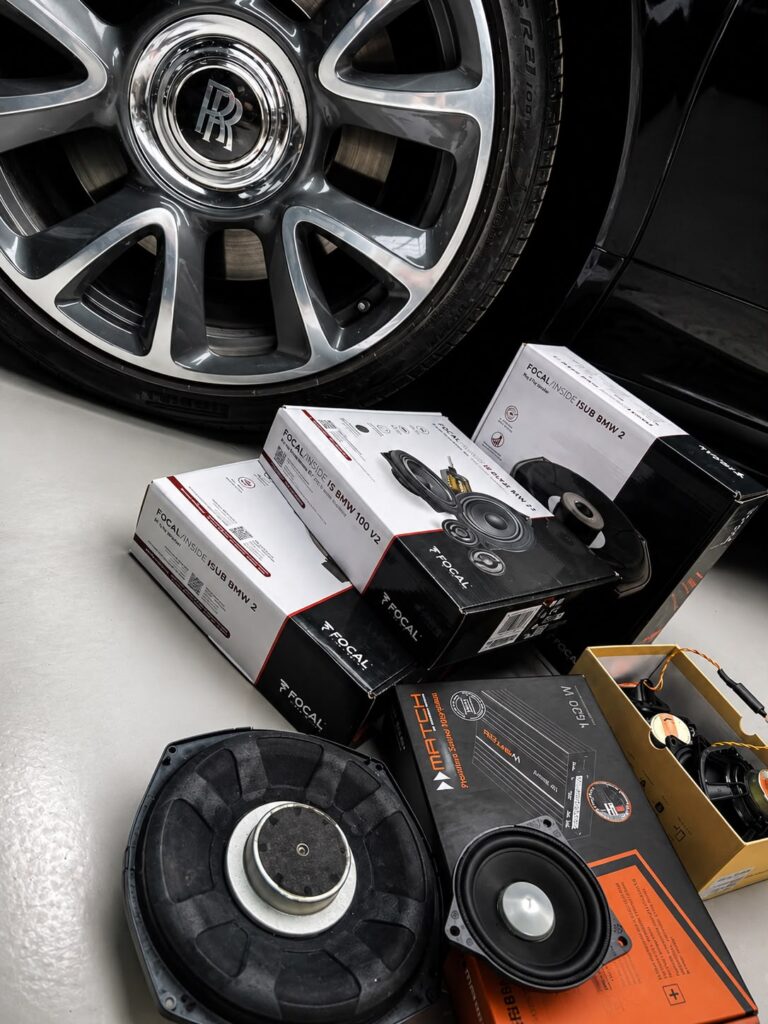
The owner had just had the car re-trimmed and wanted the audio to match the standard of the newer Rolls-Royce models. He’d researched and bought a complete system online — with ChatGPT as his advisor — and came to us for the installation. Our job was to evaluate what he’d chosen, find its strengths and weaknesses, and integrate it properly into one of the most complex audio architectures on the road: a fibre-optic MOST network.
Case 2: McLaren 720S Mansory (2019)
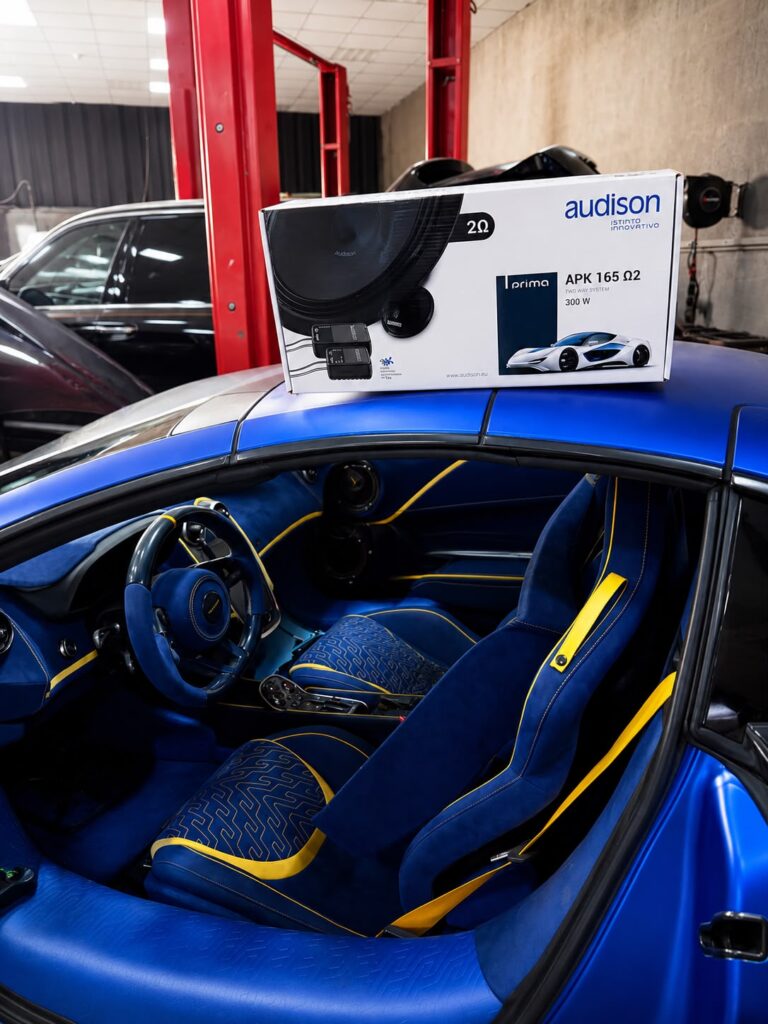
This McLaren came in with a failed door speaker. Unlike the Rolls-Royce, the 720S runs a factory amplifier system with a specific impedance requirement — the original speakers were 2-ohm. Replacing them with the wrong impedance would mismatch the factory amp, so the replacement had to match exactly. We fitted an Audison Prima component — one of the best 2-ohm options available in Dubai.
The Challenge
Rolls-Royce Ghost — The Fibre-Optic Problem
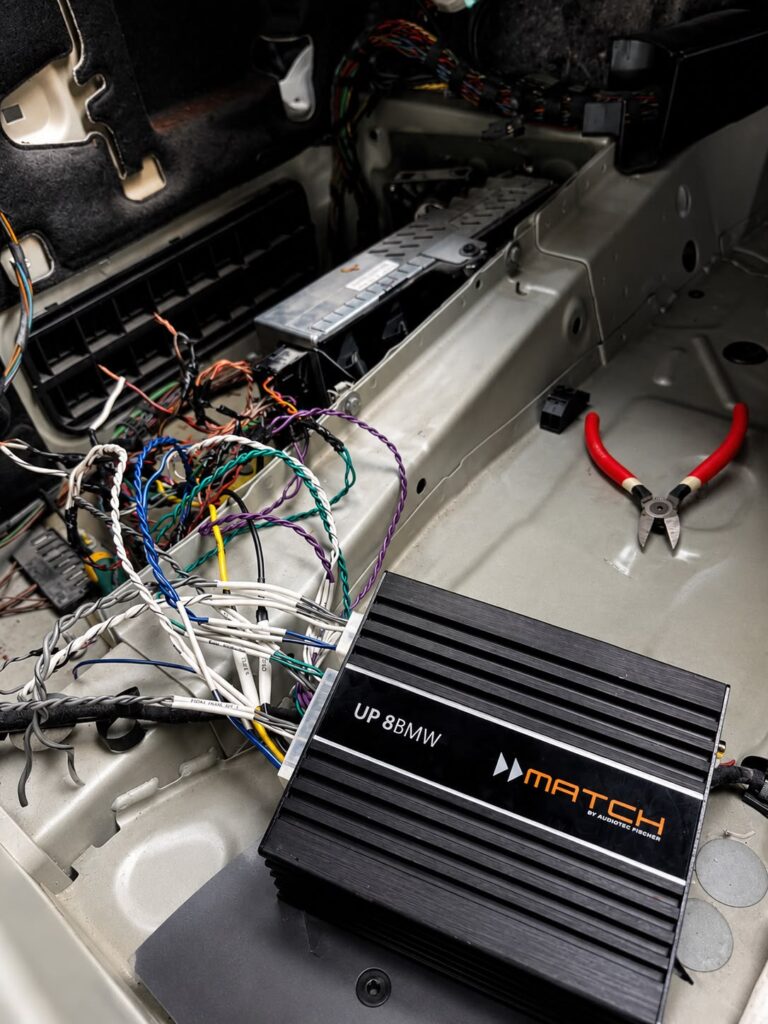
The Ghost moves all its audio as light, not copper. The head unit sends a digital signal over a MOST fibre-optic network to the factory amplifier — which means the factory amp is the only device in the car that can decode that optical signal into usable audio. It can’t be removed. The new Match UP 8BMW amplifier only accepts speaker-level input and has no MOST connection, so the only way in was to tap the signal from the factory amp’s speaker-level output — the exact point where light becomes sound.
McLaren 720S — Matching the Factory Amp
The McLaren’s challenge was different but just as strict. With a factory amplifier driving the speakers, impedance matters: the original 2-ohm speaker had to be replaced with another 2-ohm unit. Fit a standard 4-ohm speaker and the factory amp sees the wrong load — lower output, possible long-term strain. The fix wasn’t about more power; it was about respecting the system the car was built around.
The Solution
Rolls-Royce Ghost — Mapping the Signal
After studying the factory amp’s outputs, we found it has seven independent channels: four for the doors, two for the under-seat woofers, and one for the dashboard. The key discovery came from the manufacturer’s own specs (Audiotec Fischer): the Match UP 8BMW actually has six high-level inputs, not four. That changed everything.
- Front doors (L/R) → Inputs 1 & 2
- Rear doors (L/R) → Inputs 3 & 4
- Factory woofer (L/R) → Inputs 5 & 6
This mapping let the front doors and woofers run from the Match amp with full-range sound and strong bass. For the rear doors, we gave the owner two options: A) buy a MEC Analog In expansion card to add a seventh input and run everything through the Match, or B) leave the rear doors on the factory Rolls-Royce amp — slightly weaker, but no extra cost, with the option to upgrade later. He chose option B. We also confirmed that off-the-shelf BMW harnesses don’t work here, because they assume the speaker-level signal already exists in the wiring — on the Ghost, that signal only appears after the factory amp decodes the light.
McLaren 720S — The Right Impedance
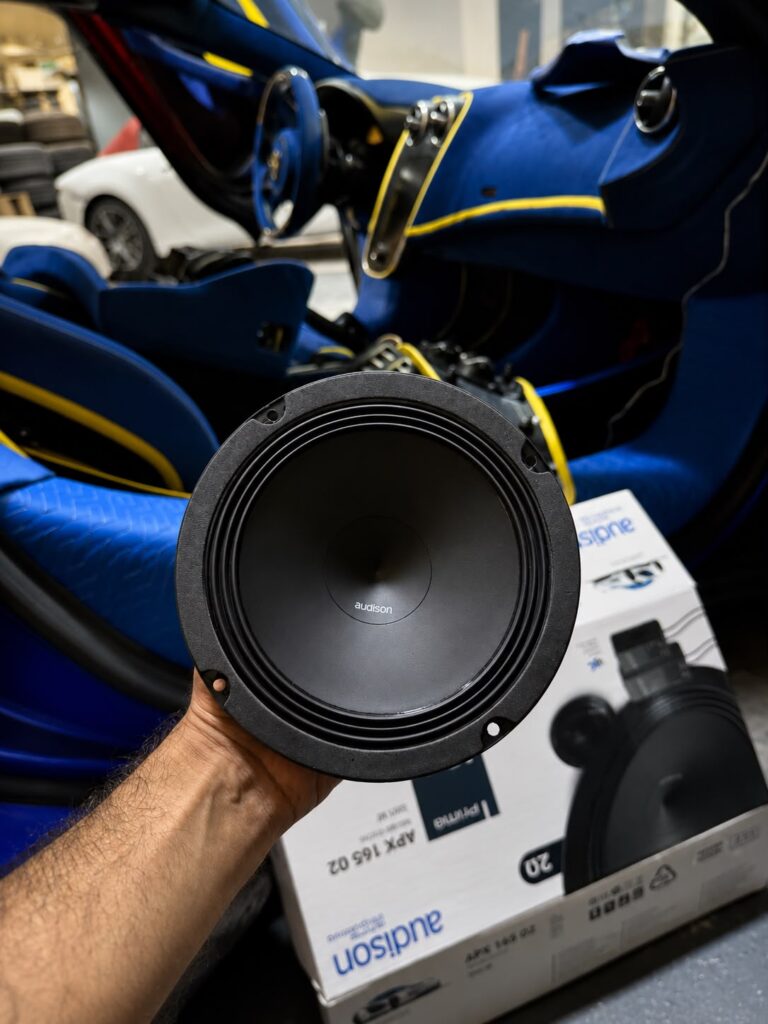
For the McLaren, the solution was precise rather than complex: source a high-quality 2-ohm component that matches the factory amplifier exactly. We fitted the Audison Prima APK 165 Ω2 (300W, 2-ohm) — restoring the failed door to full performance while keeping the factory system completely intact.
Inside the Process
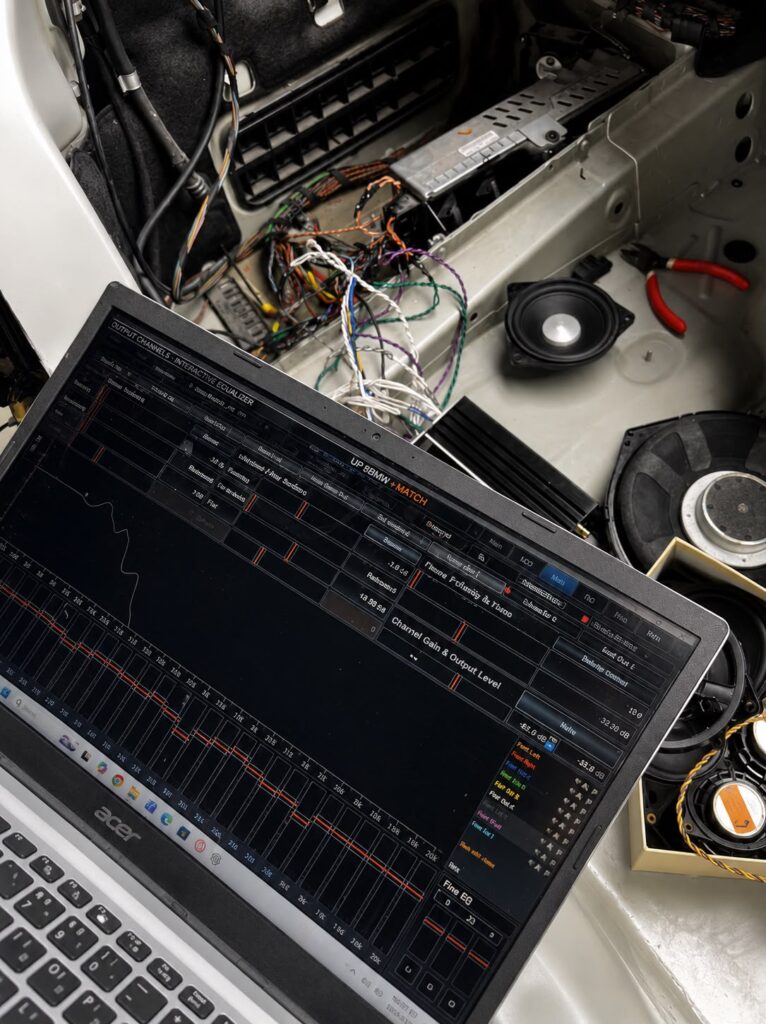
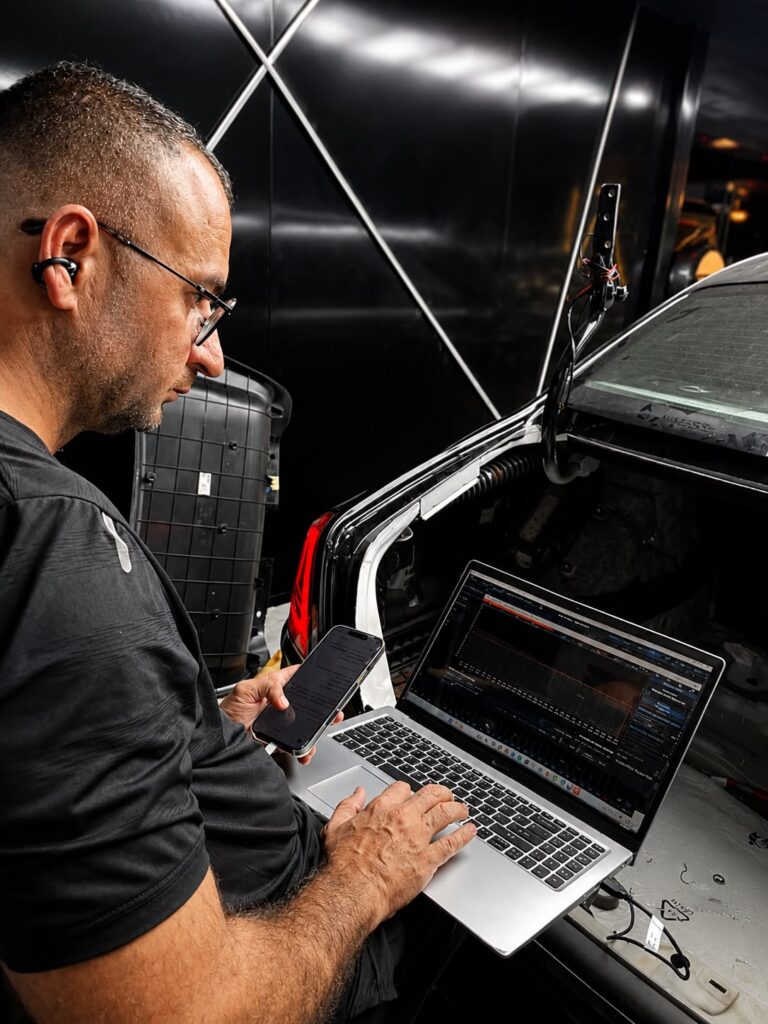
What separates a real installation from a parts swap is the tuning. On the Rolls-Royce, we worked through a structured testing process rather than guessing — measuring how each factory output behaved, then mapping inputs accordingly. Several findings only came from testing: the rear-door output was pre-filtered with no deep bass, the door channels would cut out at high volume (pointing to a voltage drop on the shared factory power line), and the woofer outputs carried the real low end. Each result shaped the final configuration.
Once wired correctly, the entire system was tuned through the Match DSP PC-Tool — crossovers, gain, phase, and time alignment dialled in channel by channel. A small sample of the recorded settings:
- Rear door — HPF: 150 Hz / Butterworth / -24 dB
- Subwoofer — LPF: 80 Hz / Butterworth / -18 dB
- Subwoofer — Output Level: -3.25 dB
- System — Input Gain: 5.5 Vrms
The Result
✓ Rolls-Royce Ghost — Focal IS BMW 100 v2 components and dual Focal ISUB BMW 2 subs fully integrated through the Match UP 8BMW DSP amplifier, factory MOST system preserved
✓ Front stage and bass running on the new amp with full DSP tuning; rear doors retained on the factory amp with a clear upgrade path
✓ McLaren 720S — Failed door restored with an impedance-matched Audison Prima APK 165 Ω2 component, factory amplifier untouched
✓ Both cars upgraded with zero damage to factory architecture — exactly the standard a luxury vehicle deserves
Why OEM-Level Matters
Both projects show why luxury car audio can’t be approached like a generic install. A Rolls-Royce moving sound as light and a McLaren built around a fixed impedance are two completely different problems — and getting either wrong means weaker sound at best, damaged hardware at worst. Buying the right components online is only half the job; the other half is knowing how to integrate them without fighting the car’s own engineering.
That’s the difference between following a spec sheet and actually understanding the system. We work from manufacturer documentation, measure instead of guess, and keep the factory architecture intact — so the result sounds better and stays reliable. Real sound is the result of real engineering.
Thinking About a Sound System Upgrade?
Whether you’ve already bought a system or want us to spec one from scratch, we’ll make sure it’s integrated the right way for your car — no compromise to the factory setup. Tell us what you drive and what you want to hear.
Related Service
This project is part of our wider car sound system upgrade service in Dubai — from single-speaker replacements to full DSP-tuned systems on luxury and performance vehicles. Learn more about what we offer and how we approach every build.
Frequently Asked Questions
Can you upgrade the sound system without removing the factory amplifier?
In many luxury cars, yes — and often you have to. Vehicles like the Rolls-Royce Ghost use a fibre-optic MOST network where the factory amplifier is the only component that can decode the audio signal. In those cases we keep the factory amp in the chain and add an external DSP amplifier on top of it, rather than replacing it.
Why does speaker impedance matter on cars like the McLaren?
Cars with a factory amplifier are tuned for a specific speaker impedance — often 2-ohm. Fitting a standard 4-ohm speaker makes the amp see the wrong load, which reduces output and can strain it over time. Matching the original impedance keeps the factory system working exactly as intended.
I bought a sound system online. Can you just install it?
Absolutely. We regularly install owner-supplied systems — but first we evaluate whether the components actually suit your car and how best to integrate them. Buying good hardware is only half the result; correct integration and DSP tuning are what make it sound right.
Will upgrading my sound system affect the factory wiring or warranty-level fit?
Done properly, no. Our approach is to preserve the factory architecture — clean signal tapping, correct harnesses, and reversible integration where possible. The goal is OEM-level results with no damage to the car’s original system.
How long does a luxury car sound system upgrade take?
It depends on the vehicle and scope. A single impedance-matched speaker replacement can be same-day, while a full multi-channel system with DSP tuning on a complex car like a Rolls-Royce takes considerably longer due to the testing and tuning involved.